
News
Why are people turning to Foodbanks? New report examines hardship across the UK
23rd September 2026
-
Share this:
- Share on facebook
- Share on twitter
- Share on linkedin
A new report exploring hardship across the UK highlights the pressures facing households who are struggling to afford everyday essentials – and the reasons why people can find themselves needing support from foodbanks.
The report, Hardship in the UK, published in September 2026, brings together evidence from the Living Costs in Context webinar series. It looks at three interconnected areas: young people, housing and crisis support.
The findings reinforce something foodbanks see every day: when household income isn’t enough to cover essential costs, even a small change in circumstances can push people into crisis.
💚 When there simply isn’t enough money
The report identifies low incomes as the main driver of hardship across all three areas examined.
It highlights concerns about income from both social security and employment, alongside the impact of deductions, delays and other pressures on household finances.
The report states that millions of people do not have enough income to cover the essentials they need, while high costs – particularly housing and energy – can leave households vulnerable when circumstances change.
This is why foodbank support can be so important. For someone already struggling to make ends meet, an unexpected bill, reduction in income or increase in household costs can mean there simply isn’t enough left for food.
🏠 The cost of housing adds to the pressure
Housing was consistently identified in the report as a major contributor to hardship.
High private rents, a shortage of social housing and inadequate housing support were highlighted, alongside problems with poor-quality housing. The report also points to the additional costs that can come with poorly insulated or unsuitable accommodation, including higher heating and travel costs.
Food prices, energy bills and transport costs were also frequently mentioned as factors that can push people towards financial crisis and charitable food support.
🥫 Foodbanks are part of a much bigger picture
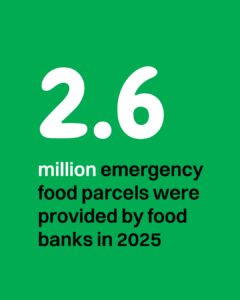
The report notes that 2.6 million food parcels were provided by foodbanks in the Trussell community during 2025, representing a 45% increase compared with 2019. It also reports that one in five people were classified as food insecure.
Behind these figures are individuals and families facing a range of circumstances. People may be dealing with high housing costs, insecure work, insufficient income, debt, rising bills or a sudden change in their situation.
The report emphasises that people turn to charitable food providers because they don’t have enough money to afford essential items.
🌱 Prevention matters
One of the report’s key messages is that support needs to reach people before they reach crisis point.
The evidence gathered highlighted the importance of adequate incomes, affordable housing, accessible advice and effective crisis support. Earlier intervention can help prevent problems such as rent arrears, debt, homelessness and the need for a foodbank referral.
The report also highlights the importance of making support easier to access and more dignified, with different services working together so people don’t have to navigate complicated systems alone.
The Hardship in the UK report makes clear that foodbank use is not simply about food – it is closely connected to household income, housing costs, the cost of essentials, and access to wider support.
Together, we can work towards a community where everyone has enough money to afford the essentials and where, ultimately, foodbanks are no longer needed. 💚